Cart
No products in the cart.
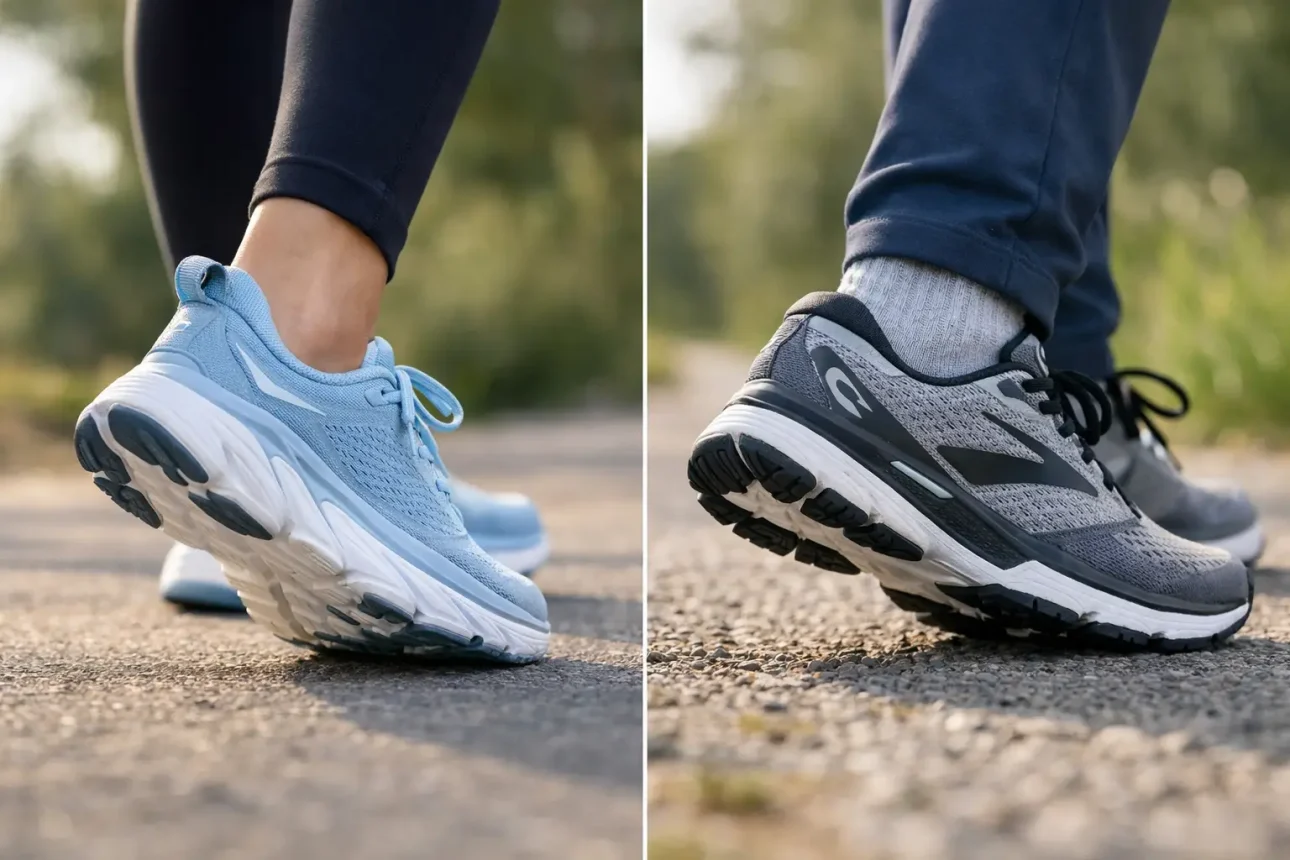
If you’re stuck on hoka vs brooks walking, here’s the short version: Hoka usually feels softer and more padded right away, while Brooks often feels more stable and easier to trust for long days on your feet. That doesn’t mean one brand is better. It means they solve comfort in different ways, and your feet will notice.
We’ve seen people buy Hoka because everyone says it feels like walking on clouds, then send it back because the shoe felt too tall or too squishy. We’ve also seen people write off Brooks as boring, then wear the same pair for months because their feet felt better at the end of the day. That’s the real split.
Hoka’s walking shoes usually lean into max cushioning. You step in, and the first thing you notice is the stack height – basically how much foam sits between your foot and the ground. It feels plush. Sometimes very plush. For some people, that’s exactly what they want. If your feet feel beat up on hard floors, Hoka can feel like a relief.
Brooks takes a different route. Most Brooks walking-friendly models feel more grounded. Not flat, not harsh, just more controlled. The cushioning is there, but it usually doesn’t swallow your foot. We like Brooks for people who want comfort without that marshmallow feeling.
If we had to take a side, we’d say this: Hoka wins on softness. Brooks wins on balance. For walking, balance matters more than people think.
This is where people make bad choices. A shoe can feel amazing for two minutes and annoying after an hour.
Hoka often nails that instant wow factor. Soft underfoot. Light on the foot for the amount of foam you’re getting. The rocker shape on many Hoka shoes also helps move you forward. That’s the curved sole shape that helps your stride roll along instead of feeling stiff. On a walk, that can feel smooth and easy.
But there is a trade-off. Some walkers don’t love how high Hokas sit. If you’re used to lower-profile shoes, that extra height can feel a little unstable at first, especially on turns, uneven sidewalks, or long work shifts where you’re constantly stopping and starting.
Brooks usually doesn’t give you that dramatic first step. It feels more normal. That’s not an insult. Normal can be good. Brooks tends to disappear on your foot in a way Hoka doesn’t always do. Less “wow,” more “I forgot I was even thinking about my shoes.” For all-day walking, that’s a strong argument.
If cushioning is your whole shopping filter, Hoka will grab your attention first. Shoes like the Bondi line have a thick, soft ride that protects you from hard pavement and concrete. If you walk a lot and like that pillowy feeling, Hoka makes a lot of sense.
Brooks cushioning is usually a bit firmer and more measured. Models like the Ghost or Addiction Walker don’t feel dead, but they don’t sink the way some Hoka pairs do either. We like that for people who want comfort but still want to feel planted.
Here’s our honest take: softer is not always better for walking. For some feet, too much softness gets tiring. Your foot works harder to stabilize itself, especially if you’re moving all day instead of just taking a short walk. That’s where Brooks often wins people over.
This part matters more than brand loyalty.
Hoka fits can be tricky depending on the model. Some run snug through the midfoot, and the shape can feel a little unusual if you’ve never worn the brand. The toe box in some models is roomy enough, but the overall feel is often more sculpted. Great if it matches your foot. Not great if it doesn’t.
Brooks tends to be easier for more people right out of the box. The fit is usually more familiar. Secure heel, decent toe space, less weirdness. If you’ve had bad luck ordering shoes online and don’t want surprises, Brooks is often the safer bet.
That said, both brands offer wider fits in key models, and that’s worth paying attention to if your feet swell during the day or you hate pressure around the forefoot. A walking shoe that feels okay in the morning can feel awful by 5 p.m.
This is where Brooks has a clear edge for a lot of walkers.
Brooks has built a strong reputation for stable, supportive shoes that don’t feel overly corrective. In plain English, they help keep your foot moving in a straighter line without making the shoe feel stiff and awkward. That’s useful if you overpronate – meaning your foot rolls inward more than usual – or if you just want a more secure ride.
Hoka has supportive options too, and some of them are very good. But across the board, Brooks feels more naturally steady for walking. The platform tends to feel flatter and more predictable. If you’re on your feet all day at work, that predictability is worth a lot.
We’d put it this way: if you want soft and smooth, look at Hoka. If you want stable and reliable, Brooks is easier to recommend.
Let’s be honest. Nobody wants a shoe that feels great and looks terrible unless the comfort is really worth it.
Hoka has done a better job becoming socially acceptable outside pure performance wear. Some pairs still look chunky – because they are chunky – but the brand has crossed over into everyday style in a way Brooks hasn’t quite matched. If you want one shoe for walks, errands, travel, and casual outfits, Hoka often looks more current.
Brooks is more practical-looking. Cleaner in some models, but rarely exciting. Some pairs scream “I care about my arches” more than “I care about my outfit.” That’s fine if comfort is your only goal. But if you’re style-conscious, Hoka usually has the edge.
We wouldn’t choose based on looks alone, but we also wouldn’t pretend it doesn’t matter.
We like Hoka for walkers who want maximum cushioning, a smoother rolling stride, and a softer ride on hard ground. It’s also a strong pick for travel days when you’ll be doing a lot of steady walking and want your feet to feel less beat up.
Hoka makes more sense if you like plush shoes and don’t mind a taller platform. It also works well for people who think most walking shoes feel too flat or too firm.
But we’d be careful with Hoka if you’re sensitive to unstable-feeling shoes or if you want a very natural connection to the ground. Some people love the high-stack feel. Some never get used to it.
We like Brooks for people who want dependable comfort without the learning curve. If you’re walking for exercise, commuting, working long shifts, or just need an everyday shoe that won’t annoy you, Brooks is often the safer call.
Brooks also makes more sense for walkers who care about support and structure more than softness. If your old shoes always collapse at the inner edge, or if overly plush shoes make you feel wobbly, Brooks is probably the better match.
And if we’re being blunt, Brooks is often better for people who don’t want to think about their shoes too much. Put them on. Walk. Get on with your day.
If someone asked us for the simplest answer, we’d say this: choose Hoka if your top priority is softness. Choose Brooks if your top priority is stability.
For most everyday walkers, we lean slightly toward Brooks. Not because it’s more exciting. It isn’t. But for regular walking, work shifts, and all-day wear, a shoe that feels steady and consistent usually beats one that feels amazing for ten minutes and strange by dinner.
That said, if hard pavement destroys your feet and you love a plush ride, Hoka can absolutely be the better buy. Some people put on a Bondi and immediately know that’s their shoe. We get it.
The mistake is assuming the internet’s favorite will be your favorite. Feet are picky. Walking style matters. So does where you walk, how long you’re on your feet, and whether you want soft, stable, or somewhere in between.
What actually matters is how your feet feel at the end of the day. Not the logo. Not the hype. If a shoe keeps you comfortable from the first errand to the last step home, that’s the right one.